Classes | |
| class | ColoredLink |
Public Member Functions | |
| record | ColoredNode (int index, Node node, List< ColoredLink > outLinks, List< ColoredLink > inLinks) |
| int | getNodeCount () |
| int | getLinkCount () |
Static Public Member Functions | |
| static TurnRestrictionsContext | build (Network network) |
Public Attributes | |
| final Network | network |
| Map< Id< Link >, ColoredLink > | replacedLinks = new HashMap<>() |
| List< ColoredNode > | coloredNodes = new ArrayList<>() |
| List< ColoredLink > | coloredLinks = new ArrayList<>() |
| Map< Id< Link >, List< ColoredLink > > | coloredLinksPerLinkMap = new HashMap<>() |
Private Member Functions | |
| TurnRestrictionsContext (Network network) | |
| ColoredLink | applyTurnRestriction (TurnRestrictionsContext context, Collection< List< Id< Link >>> restrictions, Link startingLink) |
| void | applyTurnRestriction (TurnRestrictionsContext context, Collection< List< Id< Link >>> restrictions, ColoredLink startingLink) |
| ColoredLink | applyTurnRestriction (TurnRestrictionsContext context, Collection< List< Id< Link >>> restrictions, Link startingLink, ColoredLink coloredStartingLink) |
Private Attributes | |
| int | nodeCount |
| int | linkCount |
Detailed Description
Turn restriction context that expands networks with turn restrictions with colored subgraphs.
Definition at line 16 of file TurnRestrictionsContext.java.
Constructor & Destructor Documentation
◆ TurnRestrictionsContext()
|
private |
Definition at line 28 of file TurnRestrictionsContext.java.
References org.matsim.api.core.v01.Id< T >.getNumberOfIds(), and org.matsim.core.network.turnRestrictions.TurnRestrictionsContext.network.
Referenced by org.matsim.core.network.turnRestrictions.TurnRestrictionsContext.build().

Member Function Documentation
◆ ColoredNode()
| record org.matsim.core.network.turnRestrictions.TurnRestrictionsContext.ColoredNode | ( | int | index, |
| Node | node, | ||
| List< ColoredLink > | outLinks, | ||
| List< ColoredLink > | inLinks | ||
| ) |
Definition at line 59 of file TurnRestrictionsContext.java.
References org.matsim.core.network.turnRestrictions.TurnRestrictionsContext.ColoredLink.index.
Referenced by org.matsim.core.network.turnRestrictions.TurnRestrictionsContext.applyTurnRestriction(), org.matsim.core.router.speedy.SpeedyGraphBuilder.buildWithTurnRestrictions(), org.matsim.core.network.turnRestrictions.TurnRestrictionsNetworkCleaner.collapseNetwork(), and org.matsim.core.network.turnRestrictions.TurnRestrictionsNetworkCleaner.colorNetwork().
◆ build()
|
static |
Definition at line 82 of file TurnRestrictionsContext.java.
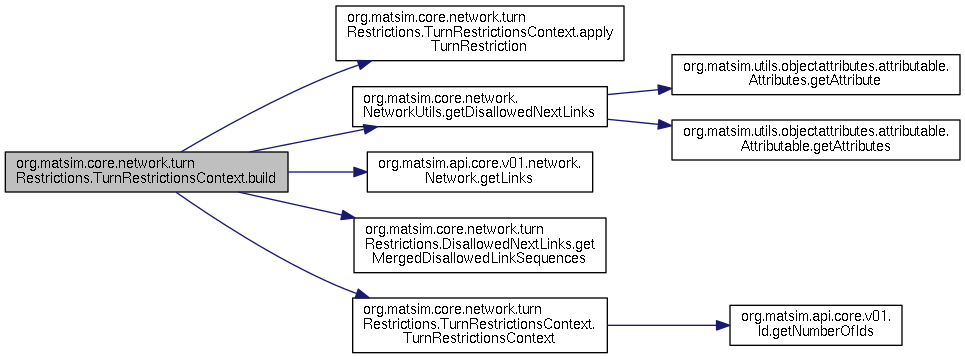
References org.matsim.core.network.turnRestrictions.TurnRestrictionsContext.applyTurnRestriction(), org.matsim.core.network.turnRestrictions.TurnRestrictionsContext.coloredLinksPerLinkMap, org.matsim.core.network.NetworkUtils.getDisallowedNextLinks(), org.matsim.api.core.v01.network.Network.getLinks(), org.matsim.core.network.turnRestrictions.DisallowedNextLinks.getMergedDisallowedLinkSequences(), org.matsim.core.network.turnRestrictions.TurnRestrictionsContext.ColoredLink.toColoredNode, and org.matsim.core.network.turnRestrictions.TurnRestrictionsContext.TurnRestrictionsContext().
Referenced by org.matsim.core.router.speedy.SpeedyGraphBuilder.buildWithTurnRestrictions(), and org.matsim.core.network.turnRestrictions.TurnRestrictionsNetworkCleaner.run().
◆ applyTurnRestriction() [1/3]
|
private |
Definition at line 144 of file TurnRestrictionsContext.java.
Referenced by org.matsim.core.network.turnRestrictions.TurnRestrictionsContext.applyTurnRestriction(), and org.matsim.core.network.turnRestrictions.TurnRestrictionsContext.build().
◆ applyTurnRestriction() [2/3]
|
private |
Definition at line 148 of file TurnRestrictionsContext.java.
References org.matsim.core.network.turnRestrictions.TurnRestrictionsContext.applyTurnRestriction().

◆ applyTurnRestriction() [3/3]
|
private |
Definition at line 152 of file TurnRestrictionsContext.java.
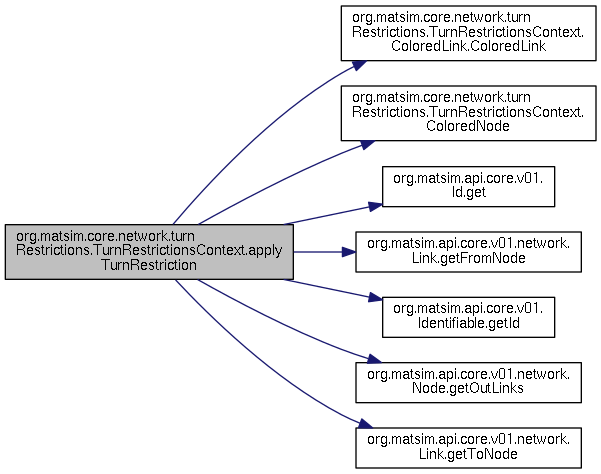
References org.matsim.core.network.turnRestrictions.TurnRestrictionsContext.ColoredLink.ColoredLink(), org.matsim.core.network.turnRestrictions.TurnRestrictionsContext.coloredLinks, org.matsim.core.network.turnRestrictions.TurnRestrictionsContext.coloredLinksPerLinkMap, org.matsim.core.network.turnRestrictions.TurnRestrictionsContext.ColoredNode(), org.matsim.core.network.turnRestrictions.TurnRestrictionsContext.coloredNodes, org.matsim.core.network.turnRestrictions.TurnRestrictionsContext.ColoredLink.fromNode, org.matsim.api.core.v01.Id< T >.get(), org.matsim.api.core.v01.network.Link.getFromNode(), org.matsim.api.core.v01.Identifiable< T >.getId(), org.matsim.api.core.v01.network.Node.getOutLinks(), org.matsim.api.core.v01.network.Link.getToNode(), org.matsim.core.network.turnRestrictions.TurnRestrictionsContext.ColoredLink.link, org.matsim.core.network.turnRestrictions.TurnRestrictionsContext.linkCount, org.matsim.core.network.turnRestrictions.TurnRestrictionsContext.nodeCount, org.matsim.core.network.turnRestrictions.TurnRestrictionsContext.replacedLinks, org.matsim.core.network.turnRestrictions.TurnRestrictionsContext.ColoredLink.toColoredNode, and org.matsim.core.network.turnRestrictions.TurnRestrictionsContext.ColoredLink.toNode.
◆ getNodeCount()
| int org.matsim.core.network.turnRestrictions.TurnRestrictionsContext.getNodeCount | ( | ) |
Definition at line 305 of file TurnRestrictionsContext.java.
References org.matsim.core.network.turnRestrictions.TurnRestrictionsContext.nodeCount.
Referenced by org.matsim.core.router.speedy.SpeedyGraphBuilder.buildWithTurnRestrictions().
◆ getLinkCount()
| int org.matsim.core.network.turnRestrictions.TurnRestrictionsContext.getLinkCount | ( | ) |
Definition at line 309 of file TurnRestrictionsContext.java.
References org.matsim.core.network.turnRestrictions.TurnRestrictionsContext.linkCount.
Referenced by org.matsim.core.router.speedy.SpeedyGraphBuilder.buildWithTurnRestrictions().
Member Data Documentation
◆ nodeCount
|
private |
Definition at line 18 of file TurnRestrictionsContext.java.
Referenced by org.matsim.core.network.turnRestrictions.TurnRestrictionsContext.applyTurnRestriction(), and org.matsim.core.network.turnRestrictions.TurnRestrictionsContext.getNodeCount().
◆ linkCount
|
private |
Definition at line 19 of file TurnRestrictionsContext.java.
Referenced by org.matsim.core.network.turnRestrictions.TurnRestrictionsContext.applyTurnRestriction(), and org.matsim.core.network.turnRestrictions.TurnRestrictionsContext.getLinkCount().
◆ network
| final Network org.matsim.core.network.turnRestrictions.TurnRestrictionsContext.network |
◆ replacedLinks
| Map<Id<Link>, ColoredLink> org.matsim.core.network.turnRestrictions.TurnRestrictionsContext.replacedLinks = new HashMap<>() |
Definition at line 23 of file TurnRestrictionsContext.java.
Referenced by org.matsim.core.network.turnRestrictions.TurnRestrictionsNetworkCleaner.advance(), org.matsim.core.network.turnRestrictions.TurnRestrictionsContext.applyTurnRestriction(), org.matsim.core.router.speedy.SpeedyGraphBuilder.buildWithTurnRestrictions(), org.matsim.core.network.turnRestrictions.TurnRestrictionsNetworkCleaner.collapseNetwork(), org.matsim.core.network.turnRestrictions.TurnRestrictionsNetworkCleaner.colorNetwork(), and org.matsim.core.network.turnRestrictions.TurnRestrictionsNetworkCleaner.reapplyRestrictions().
◆ coloredNodes
| List<ColoredNode> org.matsim.core.network.turnRestrictions.TurnRestrictionsContext.coloredNodes = new ArrayList<>() |
Definition at line 24 of file TurnRestrictionsContext.java.
Referenced by org.matsim.core.network.turnRestrictions.TurnRestrictionsContext.applyTurnRestriction(), org.matsim.core.router.speedy.SpeedyGraphBuilder.buildWithTurnRestrictions(), org.matsim.core.network.turnRestrictions.TurnRestrictionsNetworkCleaner.collapseNetwork(), and org.matsim.core.network.turnRestrictions.TurnRestrictionsNetworkCleaner.colorNetwork().
◆ coloredLinks
| List<ColoredLink> org.matsim.core.network.turnRestrictions.TurnRestrictionsContext.coloredLinks = new ArrayList<>() |
Definition at line 25 of file TurnRestrictionsContext.java.
Referenced by org.matsim.core.network.turnRestrictions.TurnRestrictionsContext.applyTurnRestriction(), org.matsim.core.router.speedy.SpeedyGraphBuilder.buildWithTurnRestrictions(), org.matsim.core.network.turnRestrictions.TurnRestrictionsNetworkCleaner.collapseNetwork(), and org.matsim.core.network.turnRestrictions.TurnRestrictionsNetworkCleaner.colorNetwork().
◆ coloredLinksPerLinkMap
| Map<Id<Link>, List<ColoredLink> > org.matsim.core.network.turnRestrictions.TurnRestrictionsContext.coloredLinksPerLinkMap = new HashMap<>() |
Definition at line 26 of file TurnRestrictionsContext.java.
Referenced by org.matsim.core.network.turnRestrictions.TurnRestrictionsContext.applyTurnRestriction(), org.matsim.core.network.turnRestrictions.TurnRestrictionsContext.build(), and org.matsim.core.network.turnRestrictions.TurnRestrictionsNetworkCleaner.collapseNetwork().
The documentation for this class was generated from the following file:
- core/network/turnRestrictions/TurnRestrictionsContext.java